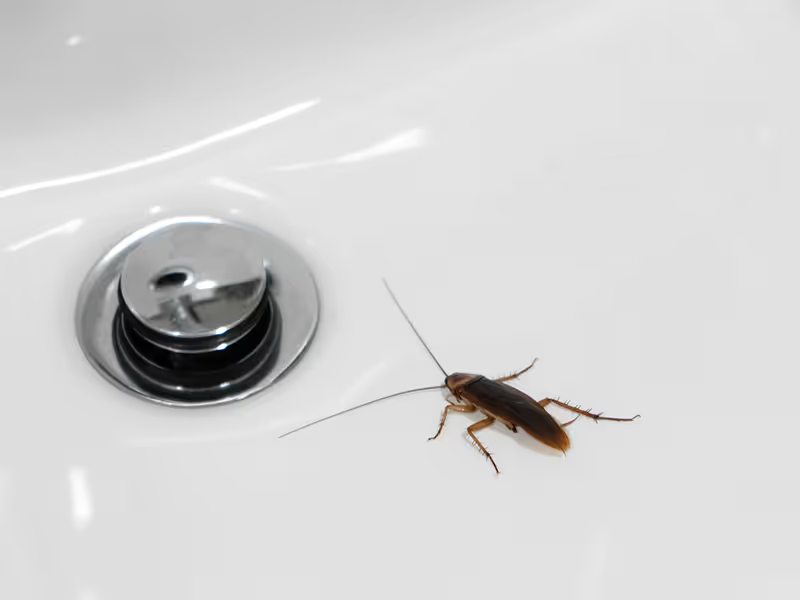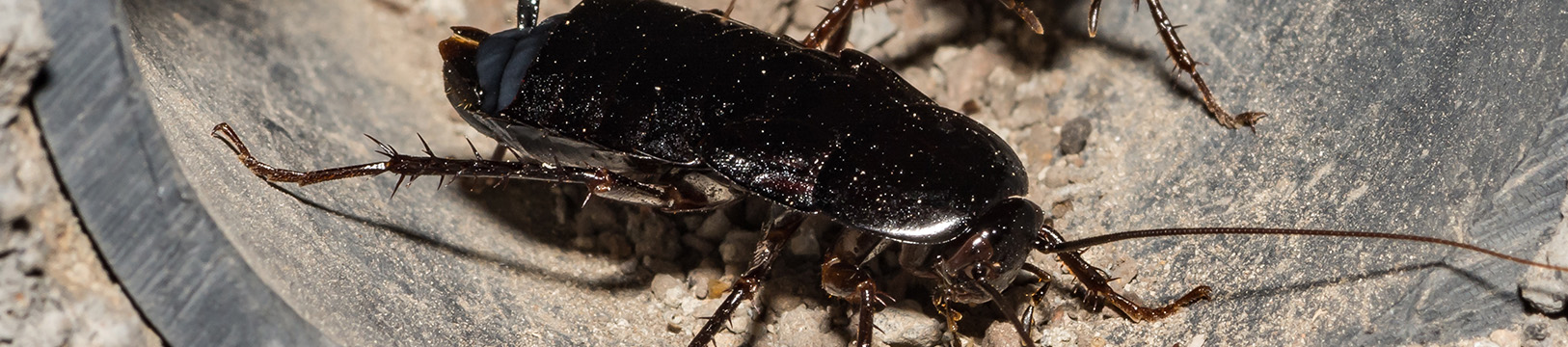
Oriental cockroaches are among the darkest of the roaches San Diego homeowners encounter. Adults are deep brown to nearly black with a smooth, glossy, almost lacquered sheen, and they run about 1 to 1¼ inches long. Their bodies look broad, heavy, and flattened, and they move noticeably slower than the American or German cockroaches you might find indoors.
Males and females look different from one another. Males have wings covering about three-quarters of the body but leave the tip of the abdomen exposed; females have only small, undeveloped wing pads and look essentially wingless. Neither one can fly. Just as importantly for a San Diego home, they can't climb smooth vertical surfaces — which is why they're so often found trapped at the bottom of a porcelain sink, tub, or floor drain after climbing up through a dry or damaged drainpipe.
Nymphs are wingless and share the same dark, glossy coloring as the adults, deepening with each molt. One note for our area: dark, short-winged female Oriental cockroaches are easily mistaken for Turkestan cockroaches, which are common locally — the Turkestan female has pale cream markings behind the head and on the wing pads, while the Oriental female is a uniform dark brown to black.
Because they cluster in damp drains, water boxes, and ground-level spaces, Oriental cockroaches are commonly nicknamed "waterbugs" or "black beetles."
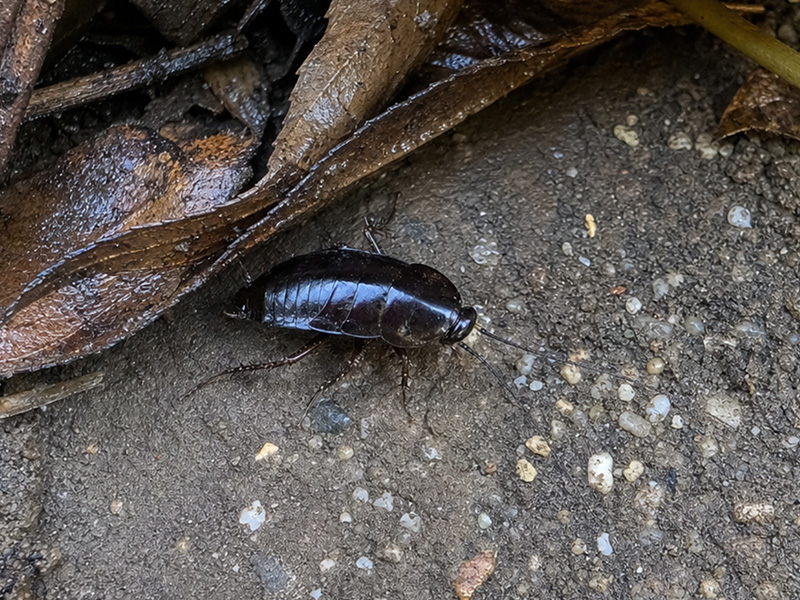
Oriental cockroaches prefer cooler, damper conditions, so their activity in San Diego builds through the mild winter and into spring, peaks in late spring and early summer, then drops off through the hot, dry stretch of late summer and early fall before climbing again with the returning rains.
Oriental cockroaches don't bite or sting, but they can create sanitation concerns. They commonly inhabit drains, sewer systems, garbage areas, and places containing decaying organic matter, where they can pick up microorganisms and mechanically contaminate food or food-contact surfaces as they move through a structure.
Cockroaches have been found carrying bacteria, including Salmonella and E. coli.
Oriental cockroaches can also produce a noticeable odor. When populations become large, secretions and other cockroach debris can create a characteristic smell in infested areas.
Like other cockroaches, their shed skins, body parts, and droppings can contribute to indoor allergens that may aggravate asthma and allergies.
More than many other pest cockroaches, Oriental cockroaches are strongly associated with moisture. In San Diego's relatively dry climate, irrigation, plumbing leaks, drainage areas, and other persistent moisture sources can create favorable habitat around a property.
Common areas where they may find moisture and shelter include:
Consistently damp conditions around a structure can allow Oriental cockroaches to remain established outdoors and increase the chances that some will eventually make their way inside.
In San Diego, Oriental cockroaches usually live outdoors around the property and move inside at ground level. They can enter through gaps beneath exterior doors, cracks around foundations, and openings where plumbing or utility lines pass through the structure.
They can also come through drain systems when a trap has dried out from disuse or when plumbing is damaged. A regularly used drain normally maintains a water seal that helps block pests from moving through the pipe.
Because Oriental cockroaches stay close to cool, damp areas, they are most often encountered on ground floors and lower levels.
These roaches stay low and seek out cool, damp spots rather than the warm, high places other species prefer. Around San Diego homes, look for them:
Outdoors, they may gather in water meters and irrigation boxes, beneath mulch, leaf litter, stones, and firewood, under dense ground cover, and in damp soil along foundations. During San Diego's dry season, irrigated landscaping and other consistently damp areas can provide a favorable habitat around homes and other buildings.
Oriental cockroaches reproduce more slowly than German cockroaches, but established populations can persist for a long time. A female produces dark reddish-brown egg capsules, called oothecae, about ⅜ inch long. Each typically contains around 16 eggs and is deposited in a sheltered, humid location.
A female and her offspring can produce close to 200 cockroaches over the course of a year under favorable conditions.
Development is relatively slow and strongly influenced by temperature and moisture. Going from a newly hatched nymph to a mature adult can take one to two years or more. Consistently damp outdoor areas can therefore support populations around San Diego properties over time.
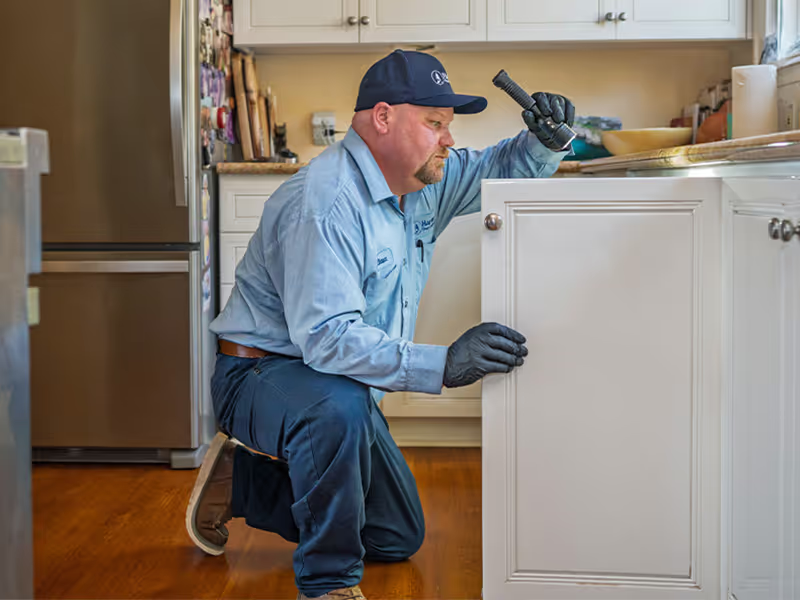
Because Oriental cockroaches breed outdoors and move in at ground level, spraying the ones you see rarely solves the problem. Lasting control means addressing the moisture and harborage around your property along with the insects themselves. Harbor Pest Control's home pest control services are built for exactly this: our licensed technicians pinpoint where these roaches are living and breeding, treat those areas directly, and establish a protective barrier around your home's exterior. We also provide commercial pest control for restaurants, offices, and other San Diego businesses, where drains, loading areas, and landscaping can give Oriental cockroaches an easy way in.
Providing trusted residential pest control in San Diego since 1948, we're ready to help you take back your property — contact us today to get started.
Reducing excess moisture and limiting sheltered areas around a structure can make a property less favorable to Oriental cockroaches. Plumbing leaks, persistent irrigation runoff, damp debris, and openings around doors or utility penetrations are all worth addressing when they contribute to activity.
However, because Oriental cockroaches commonly live outdoors and may also be associated with drains, utility areas, landscaping, and neighboring habitat, prevention alone does not always stop them from reaching a structure.

Have an annual contract with Harbor for termites which is very superior. Called this year for rodent treatment which even after the first month had truly amazing results. Have been with Harbor Pest Control for over 30 years and they have earned our 5 star rating throughout this period.
Daniel M.
San Diego, CA

We've been using the same company for 20+ years because they are always prompt for inspections, seem very thorough with the inspections, and have very pleasant, personable personnel.
Dianne L.
San Diego, CA

Professional, on time, and service delivered as expected.
Susan T.
San Diego, CA



Helpful Tips & Info