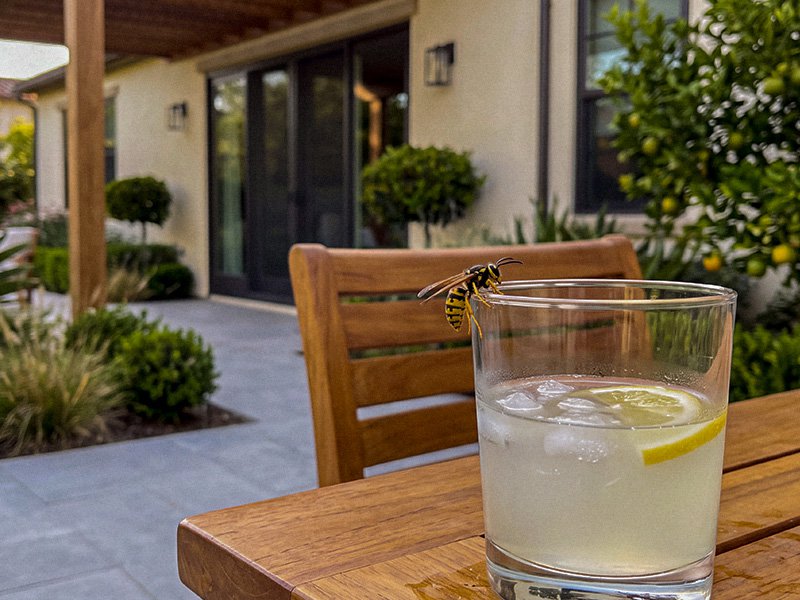
Yellow jackets are compact, smooth-bodied wasps. They have bright yellow and black markings, a narrow waist, and very little body hair, which gives them a shinier appearance than honey bees. Workers are typically about 3/8 to 5/8 inch long, while queens may be larger.
Their flight pattern can also help with identification. Yellow jackets tend to fly quickly and directly, with their legs tucked close to their bodies. Paper wasps usually move more slowly and often fly with their long legs hanging below them.
If you see several yellow-and-black wasps repeatedly disappearing into the same hole in the lawn or soil, a yellow jacket nest is a strong possibility.
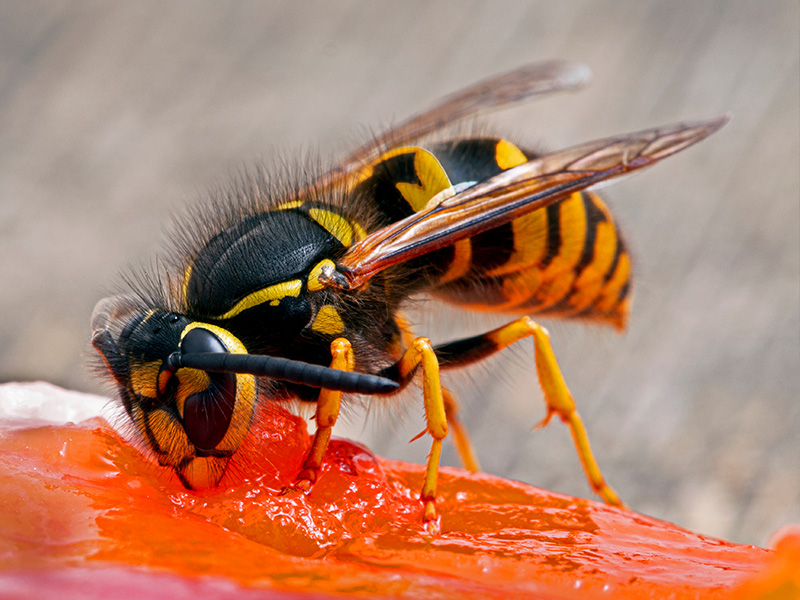
Yellow jackets are most active in San Diego from July through October. Activity starts increasing in spring, peaks in late summer and early fall, and generally slows from November through winter.
Two species commonly cause problems around San Diego homes:
Western yellow jacket (Vespula pensylvanica)
One of the yellow jacket species most commonly encountered in California. Western yellow jackets usually nest underground in old rodent burrows, slopes, planter beds, and other protected ground cavities. They are also frequent visitors to trash areas, outdoor meals, and other sources of meat and sweets.
German yellow jacket (Vespula germanica)
A yellow jacket commonly associated with urban areas. German yellow jackets may nest underground, but they are also more likely to establish colonies inside wall voids, attics, crawl spaces, and other parts of a structure.
Large exposed nests hanging from shrubs, trees, or rooflines may belong to a different type of wasp. Nest location is often an important clue when identifying the insect.
Yellow jacket nests can be difficult to spot because many are hidden underground or inside structures.
Around San Diego homes, nests may be found:
One of the clearest signs of a hidden nest is repeated traffic through a single opening. If yellow jackets are steadily flying in and out of the same hole, the colony may be located well beyond the visible entrance.
Yellow jacket feeding habits change as the colony develops.
Earlier in the season, workers hunt insects and other sources of protein to feed developing larvae. Later in summer and fall, yellow jackets become much more interested in sugary foods and human food scraps.
Common attractants around San Diego properties include:
Seeing yellow jackets around food does not necessarily mean the nest is nearby, but consistent traffic in one part of the yard may be worth investigating.
Yellow jackets can sting repeatedly and may defend their nest in large numbers.
People are often stung after unknowingly disturbing an underground nest while mowing, trimming, digging, or working in the yard. Vibrations and activity close to a nest entrance can trigger defensive behavior.
Most yellow jacket stings cause temporary pain, redness, and swelling. Multiple stings, stings around the mouth or throat, or an allergic reaction require more immediate attention.
If yellow jackets repeatedly enter and leave a location, avoid disturbing the area until the nest can be evaluated.
No. Yellow jacket nest removal is best left to a pest control professional.
Yellow jacket nests can extend well beyond the visible entrance, especially when they are underground or inside a wall void. Spraying the opening may not reach the colony and can cause the wasps to become defensive.
Sealing an active nest inside a structure can also create problems, since trapped yellow jackets may find another way out and enter the living space.
Because yellow jackets can sting repeatedly and defend the nest as a group, professional treatment is the safer and more effective approach.
Harbor Pest Control provides professional bee and wasp control for yellow jacket problems throughout the San Diego area.
Our technicians identify the stinging insect, locate the nest or primary entry point, and determine the most appropriate treatment based on where the colony is located. Yellow jackets may nest underground, inside walls, or in other hidden spaces, so finding the source is an important part of effective control.
Harbor technicians use professional equipment and protective gear to treat active yellow jacket nests while minimizing unnecessary disturbance around the property.
For qualifying properties, Harbor’s bee and wasp control service includes a five-day guarantee.
For homeowners who want ongoing protection, Harbor’s year-round home pest control plan covers common household pests, with stinging insect coverage available as an add-on. Additional fees may apply.
If you are seeing yellow jackets regularly or have found an active nest entrance, contact Harbor Pest Control to request a free stinging insect inspection.
Typically, no. New queens usually build new nests rather than reusing old ones, although the same protected nesting area may be used again in a future season.
Yes, to some extent. Yellow jackets visit flowers for nectar and can move pollen between plants, but they are primarily predators and scavengers rather than major pollinators.
Not necessarily. Yellow jackets can travel away from their nest while searching for food and water. Seeing one or two does not always mean a nest is nearby, but frequent activity in the same area may be a sign that one is close.
Harbor Pest Control has served San Diego since 1948 and provides professional solutions for yellow jackets and other stinging insects.

Have an annual contract with Harbor for termites which is very superior. Called this year for rodent treatment which even after the first month had truly amazing results. Have been with Harbor Pest Control for over 30 years and they have earned our 5 star rating throughout this period.
Daniel M.
San Diego, CA

We've been using the same company for 20+ years because they are always prompt for inspections, seem very thorough with the inspections, and have very pleasant, personable personnel.
Dianne L.
San Diego, CA

Professional, on time, and service delivered as expected.
Susan T.
San Diego, CA



Helpful Tips & Info