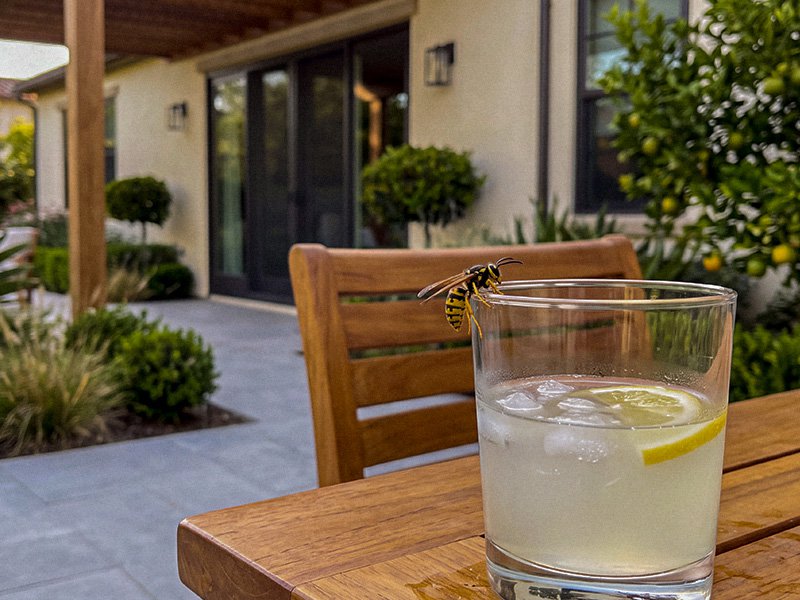
Why Wasp Activity Increases in Late Summer
Social wasps establish their colonies earlier in the year. Through spring and early summer, workers gather food and care for developing larvae while the colony grows.
By late summer, an established colony can contain far more wasps than it did when the nest first formed. That means more workers moving between the nest and nearby food and water sources.
Their food preferences also begin to change.
Earlier in the season, wasps spend much of their time hunting insects that provide protein for developing larvae. Later in the summer, yellow jackets become increasingly interested in sugary foods. That is why they may suddenly seem determined to investigate soda cans, fruit, desserts, recycling containers, and outdoor meals.
In San Diego’s mild coastal climate, this activity may continue well into fall. Some yellow jacket colonies in coastal California can even survive beyond a single season when conditions remain favorable.
Where San Diego Homeowners May Notice Wasps
Late-summer activity is often easiest to spot around the parts of a property that provide food, water, shelter, or a protected nesting location.
Homeowners may notice wasps around:
- Patio tables and outdoor kitchens
- Trash and recycling containers
- Swimming pools and fountains
- Pet food or water bowls
- Fruit trees and fallen fruit
- Roof eaves and overhangs
- Patio covers and outdoor light fixtures
- Sheds, fences, and stored outdoor items
- Gaps around walls, rooflines, and utility openings
Seeing one wasp pass through the yard does not necessarily mean there is a nest on the property. Repeated activity in one location is more significant.
Paper Wasps and Yellow Jackets Behave Differently
Not every wasp around a San Diego home presents the same situation. Two of the most important to watch for are paper wasps and yellow jackets.
Paper Wasps
Paper wasps have slender bodies, narrow waists, and long legs that may hang beneath them as they fly.
They build open, umbrella-shaped nests with visible cells. These nests are commonly attached beneath eaves, patio covers, railings, light fixtures, and other sheltered surfaces.
Paper wasps usually focus on nest defense rather than approaching people without a reason. Problems are more likely when a nest is near a door, walkway, patio, play area, or other place people regularly use.
A homeowner may also disturb a nest accidentally while trimming plants, moving furniture, opening a gate, or cleaning beneath an overhang.
Yellow Jackets
Yellow jackets have more compact bodies and noticeable yellow-and-black markings. They are scavengers, so they are the wasps homeowners commonly encounter around food, drinks, garbage, pet dishes, and ripe fruit.
Their nests may be hidden underground, inside a wall void, or in another protected cavity. Because the nest itself may not be visible, the first clue is often a steady stream of wasps entering and leaving one small opening.
Yellow jackets often defend their nesting area in large numbers. Yardwork, lawn equipment, foot traffic, or moving an object near a concealed entrance may bring someone closer to the colony than intended.
Does Increased Activity Mean There Is a Nest Nearby?
Not always.
Wasps can travel away from their nests while searching for insects, sweets, meat, or water. A few wasps visiting flowers, a pool, or an outdoor meal may be coming from somewhere beyond the property.
A consistent flight pattern provides a better clue.
From a safe distance, look for wasps that are:
- Entering the same crack or opening repeatedly
- Flying beneath one section of the roof
- Disappearing into a hole in the soil
- Gathering around one part of a shed or patio cover
- Moving in and out of a wall, vent, or utility opening
Regular traffic to and from a single location may indicate a nearby nesting site, even when the nest is hidden.
Why Nests Can Go Unnoticed Until Late Summer
A paper wasp nest may blend into the shaded underside of an eave or patio cover, especially when it is still small. A yellow jacket nest may remain completely hidden below ground, behind landscaping, or inside a structural void.
Homeowners can pass the same location for weeks without realizing there is a nest nearby.
By late summer, a paper wasp nest may be larger and easier to see. Hidden yellow jacket nests may not become visible, but the growing number of workers entering and leaving the nesting area can make their location more obvious.
The problem may also come to your attention when something changes. You may trim a shrub, move patio furniture, clean along the roofline, open a rarely used gate, or begin seeing wasps near an upstairs window.
Harbor’s Bee and Wasp Control Service
When a nest is too close to the home or an area your family uses, Harbor Pest Control can help. Our local, family-owned pest control company provides bee and wasp control services throughout San Diego, including communities such as Chula Vista, La Jolla, and Coronado.
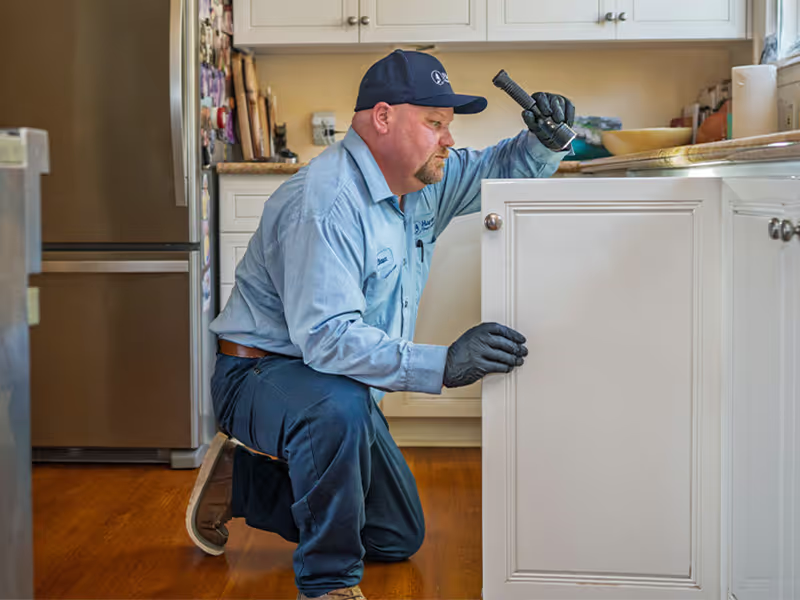
Our highly trained technicians inspect the area, identify the insect, locate the nest, and apply targeted treatments as needed. Harbor treats wasp nests located inside and outside structures. For established honey bee colonies, we will recommend a trusted local beekeeper.
For qualifying properties, Harbor’s bee and wasp service includes a five-day guarantee. If stinging insects return to the treated area during that period, we will return at no additional charge.
Add Stinging Insect Coverage to Year-Round Pest Control
Wasps are not the only pests that stay active as summer winds down. San Diego’s mild climate allows ants, cockroaches, spiders, and other pests to remain active throughout much of the year.
Harbor offers an ongoing home pest control plan that addresses current pest activity and provides continued protection through quarterly exterior pest treatments. Interior service is available as needed.
Homeowners can also add stinging insect coverage to an ongoing plan for an additional fee.
That added coverage may be worth considering when paper wasps or other stinging insects repeatedly build nests around rooflines, patios, sheds, or other areas of the property.
Frequently Asked Questions
Why do wasps keep flying around my swimming pool?
Wasps visit pools and other damp areas for water, especially during warm, dry weather. Regular flights in one direction may point to a nearby nest.
Can wasps get inside through bathroom or kitchen vents?
Yes. Wasps may enter through damaged screens or gaps around exterior vents. Activity near a vent can also indicate a nest in a nearby wall or roof void.
Why am I finding wasps inside but cannot see a nest?
One wasp may have entered through an open door or window. Repeated sightings could indicate activity in an attic, wall, chimney, or another hidden space.
Will the same wasp nest keep getting larger forever?
No. Social wasp colonies have a seasonal life cycle. However, San Diego’s mild climate may allow some yellow jacket colonies to remain active longer and grow unusually large.
Do wasps return to old paper nests?
Paper wasps usually build new nests. However, they may choose the same protected area again if it continues to provide suitable shelter.
Take Back Your Patio and Yard
Late-summer wasp activity is common in San Diego, but a nest should not prevent your family from using the patio, walking through the yard, or opening the front door comfortably.
If wasps are nesting too close to the home—or you are not sure what type of stinging insect you are seeing—we can help.
Contact Harbor Pest Control to schedule a free inspection.