You Caught One Rodent, But There May Be Others
It's easy to think that catching a mouse or rat means you've reached the end of the problem.
Sometimes you have. Other times, you've removed only one animal from a larger problem.
The number of rodents you've caught doesn't necessarily tell you how many were present to begin with. If you're still hearing noises, finding fresh gnaw marks, or noticing other new activity after catching a mouse or rat, there may still be rodents in the home.
Harbor's guide to signs of rodents in San Diego homes explains some of the evidence that can indicate mice or rats are still active.
Your Trapping Strategy May Be Working Against You
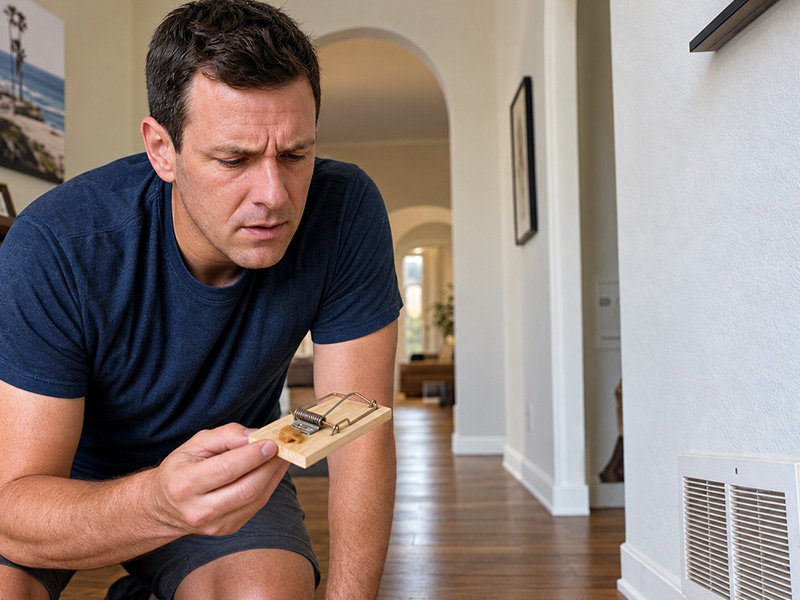
Setting a trap seems straightforward, but mice and rats don't necessarily respond to traps in the same way.
Rats can be particularly cautious when something unfamiliar suddenly appears in an area they regularly use. Rats may avoid new objects, foods, traps, and baits for several days or even weeks. This tendency can be especially pronounced in roof rats. Rats that have a negative encounter with a trap may also become more wary of it afterward.
Mice are generally less cautious around traps, but placement still matters. Mice commonly travel along walls and other edges, so a trap sitting in the middle of an open area may be less likely to intercept them.
Bait can affect the results, too. Peanut butter is commonly used for mice, but UC IPM notes that the best bait may be a food they're already eating in the home. The amount matters as well; too much bait can sometimes be removed without triggering the trap.
The rodent involved matters, too. House mice, roof rats, and Norway rats don't necessarily use a home in the same way. Roof rats are skilled climbers and frequently use elevated areas, while Norway rats are more commonly associated with lower levels and ground-level areas.
This is why a few unsuccessful traps don't necessarily mean the rodents are gone. Species, behavior, placement, bait, and previous encounters with traps can all affect trapping results.
The Activity May Be Happening Where You Can't See It
Sometimes you know rodents are still active without actually seeing one. Harbor hears from San Diego homeowners who report scratching in walls, ceilings, or crawl spaces, even when they haven't spotted a mouse or rat in a living area.
Rodents can move through wall voids, attics, crawl spaces, and other concealed parts of a home. If you're focusing your efforts only on the room where you first noticed activity, you may not be addressing where the problem is actually occurring.
A professional inspection can help determine where that activity is concentrated and which areas need attention.
Rodents May Still Have a Way Into Your Home
You can remove the rodents currently inside and still end up with another problem if mice or rats can continue getting in.
Rodents tend to exploit openings around doors, utility penetrations, vents, rooflines, crawl spaces, and other parts of a structure. Mice can fit through very small openings, while roof rats can reach upper portions of a home by climbing trees, vegetation, fences, utility lines, and other structures.
If you want a closer look at where to check, our guide to rodent-proofing your San Diego home covers common entry points and prevention steps.
Removing rodents and preventing access are two different parts of resolving a rodent problem. If you address one without the other, activity can continue or return.
Food and Shelter Can Keep Rodents Around
A rodent doesn't need a messy house to find what it needs.
Pet food, pantry goods, bird seed, garbage, fallen fruit, water, and cluttered storage areas can provide food, water, or shelter. Outdoors, dense vegetation and other protected areas can also make a property more attractive to rats.
Cleaning up food and reducing potential shelter are worthwhile efforts, but they don't mean rodents already inside will simply leave.
These steps are most useful as part of a broader approach that also addresses the rodents currently present and how they're entering the home.
You May Be Relying on Something That Doesn't Solve an Infestation
There's also a difference between taking action and taking action that addresses the problem.
Peppermint oil, mothballs, ultrasonic plug-ins, baking soda, and other home remedies are frequently suggested as ways to get rid of rodents. As we explain in our guide to DIY rodent control and common home remedies, these approaches don't tell you how many rodents are present, where they're active, or how they're entering your home.
Even trapping, which is a legitimate rodent control method, works best when the species, activity areas, trap placement, and other conditions are taken into account.
If you've been trying one thing after another while activity continues, the next step shouldn't necessarily be another product. It may be time to find out why the problem hasn't stopped.
How Harbor Pest Control Approaches an Ongoing Rodent Problem
If you've already caught a mouse or rat but still have rodents running around your home—or you're not sure what's going on and simply want a professional to take a look—contact Harbor Pest Control.
Our local, family-owned pest control company has been helping San Diego homeowners since 1948. We'd be happy to send out a technician for a free inspection to identify the rodent problem and determine where activity is occurring.
Harbor's home pest control service can address existing mouse or rat activity, and ongoing service helps prevent rodents and other common household pests from becoming a problem again.
Get Help With Mice or Rats in Your San Diego Home
Whether you just spotted the first sign of rodent activity or you've already tried to get the problem under control, Harbor Pest Control can help.
Serving National City, Imperial Beach, El Cajon, and homes throughout the San Diego area, you can trust our highly trained, fully licensed team to provide dependable pest control for mice, rats, and other common household pests.
Contact Harbor Pest Control to schedule your free inspection.